Monitoring and evaluation is an important part of effective vertebrate pest management, both before you start a program and to measure the success of program activities.
Looking for something?
CloseSince 2012 Feedback


Powered by the Centre for Invasive Species Solutions

Powered by the Centre for Invasive Species Solutions



View our best practice community engagement information hub ‘Community Invasives Action‘ to enhance community involvement in your invasive species management programs
Powered by the Centre for Invasive Species Solutions
View our best practice community engagement information hub ‘Community Invasives Action‘ to enhance community involvement in your invasive species management programs
Powered by the Centre for Invasive Species Solutions


It is essential to monitor the effects of any pest animal management activity to ensure it is having the desired results. Pest animals are one of many land management problems that can affect the functioning of agricultural production systems and ecosystems. These systems are complex and we do not fully understand them, so it is important to consider the effects different management interventions might have, and potential unexpected or unwanted outcomes. An important part of effective pest management is evaluating the results of a program against the outcomes you intended to achieve.
Ongoing, long-term monitoring and evaluation allows pest managers to:
There are two types of monitoring that can provide valuable information about the effectiveness of a pest management strategy.
Monitoring is a crucial part of management but it can require a lot of time, money and effort, so it is important to determine the monitoring objectives: what information needs to be collected and why, when, where and how data will be collected.
Most importantly, it needs to be clear how the information will be used. Some monitoring data might be easy to obtain through routine processes (eg at lamb marking), while other data (eg breeding success and recovery of native animal populations) can require specialised collection methods and might be more difficult to determine. There are a range of monitoring techniques for pest animals2 and their use varies depending on the target animal, the location, climate and time of year, and the equipment and resources available.
Monitoring is designed to provide evidence that the desired outcomes are being achieved through management. These outcomes are usually set out as objectives in a pest animal management plan (see Planning strategic pest animal management), and typically include a reduction in the level of damage being caused by pest animals, or reduced pest populations as an indication of a reduction in pest damage. Operational monitoring might show that the actual costs of control (eg dollars spent on contractors or equipment hire) are less than the anticipated costs, and thus demonstrate the program’s cost-efficiency.
Monitoring potential non-target impacts and flow on effects of pest animal management is also recommended, particularly if there is a risk or likelihood of potentially undesirable outcomes (eg removing introduced predators such as cats may result in the expansion of local rat populations3 , or poisoning rabbits on offshore islands might affect predatory birds – see Rabbit eradication on offshore islands).
Camera traps in wildlife monitoring and research has continued to develop in Australia in recent years. Camera traps are used as a tool to conduct surveys or record general observations, often with the inherent assumption that they will result in high quality data with less investment by staff, thereby improving cost-benefit ratios. This has been reinforced by claims that camera trapping provides better results than standard surveys, such as live-trapping. Such assumptions and claims, however, need validating for the range of species and situation of interest. That is, considerably more research is required before many existing methods can confidently be replaced with camera trapping alternatives.
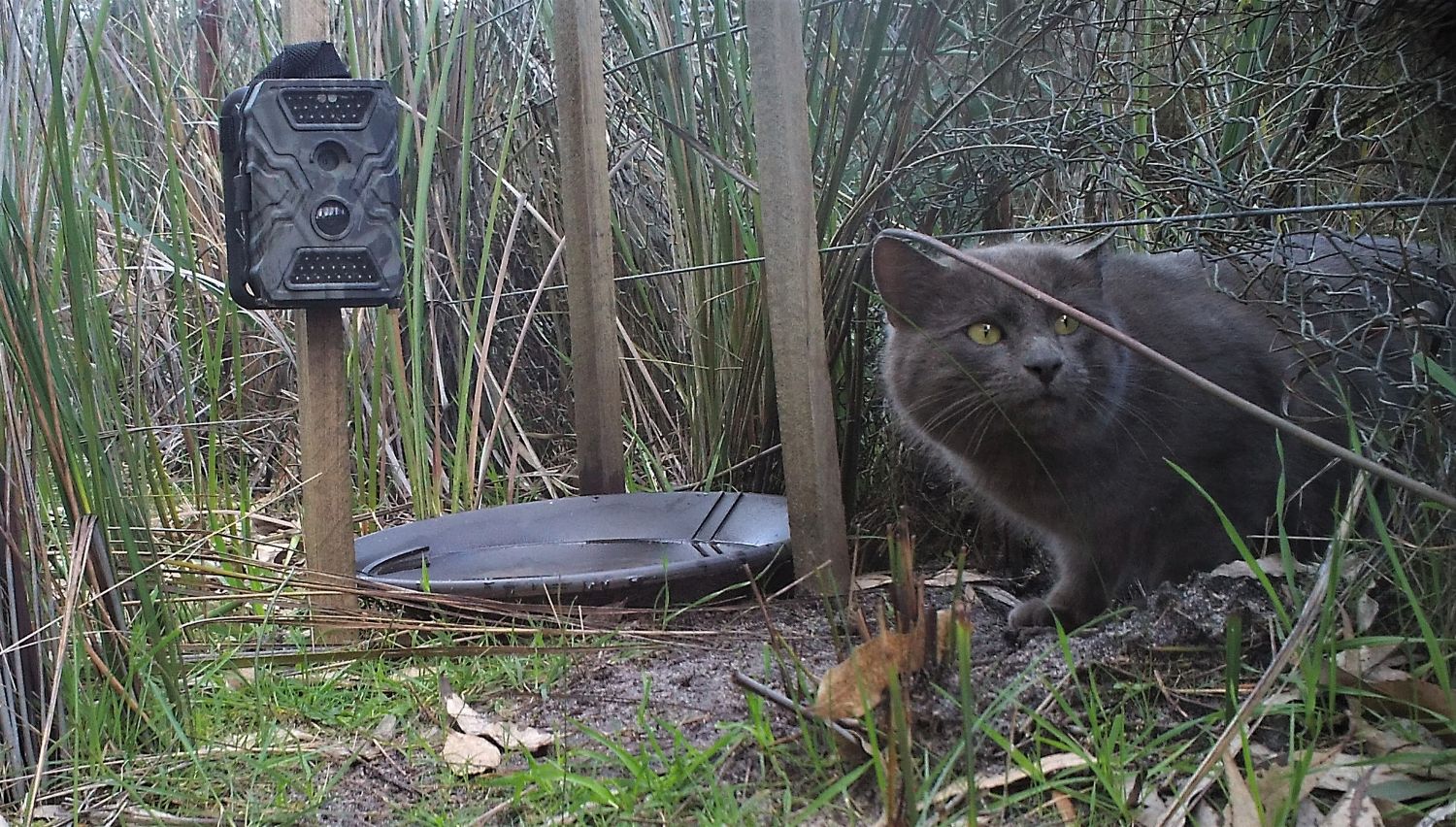
Image credit: Lisette Mill.
Collecting animal scats can be a useful way to monitor invasive animal activity. Animal scats can provide information on which pest animal species are present in an area, the diet of these animals, and the presence of specific parasites and diseases in a population. Scats may also be a source of DNA samples for research. Monitoring is an important part of effective vertebrate pest management, both before you start a program and to measure the success of program activities. FeralScan is a great way to record pest animal activity, sightings and evidence.
This video demonstrates how to use spotlights to look for pest animals.
Once monitoring data has been collected, it needs to be analysed — and the results should be used to improve or modify the program.
Depending on the type of program and what is being monitored, data analysis can range from basic calculations (eg spotlight counts, project costings) to more complex statistical analyses using mathematical formulas and software (eg measures of density and absolute abundance).
In most cases, data analysis does not need to be complex and simple calculations that enable comparison of the results against the expected outcomes can determine if the management program is working.
It is important that data collection and analysis is carried out in a timely manner, and that results are communicated between all stakeholders (particularly to those people doing the control and monitoring) so that the planning and management actions reflect the most current monitoring results.
Monitoring data that shows the value and widespread benefits of a collaborative approach can be used to seek additional funding. Data that is communicated regularly can also help motivate participating landholders and data collectors to keep going with the program.
Sharing positive results through newsletters, meetings and local media helps to boost support from the community and maintains the social license needed to continue pest management.
Where relevant, particularly for community mapping programs, data collected from these techniques can also be placed into FeralScan so data can be consolidated and used to inform future management approaches.
The nature and extent of pest problems can change over time so management interventions need to be evaluated periodically to ensure that objectives are being met and to determine that management is still appropriate.
Evaluation of a pest management program that is achieving its desired outcomes might indicate that operations can be scaled back or modified to run more efficiently. If monitoring data shows that management is not having the desired results, or if the operational circumstances have changed (eg there has been a severe weather event or financial loss), the control program might need to change or stop completely. An adaptive management approach uses monitoring data and program evaluation to inform decision-making about future management4 .
Monitoring ultimately provides pest and land managers with comprehensive data that can guide and streamline management planning, and help save on project costs.